
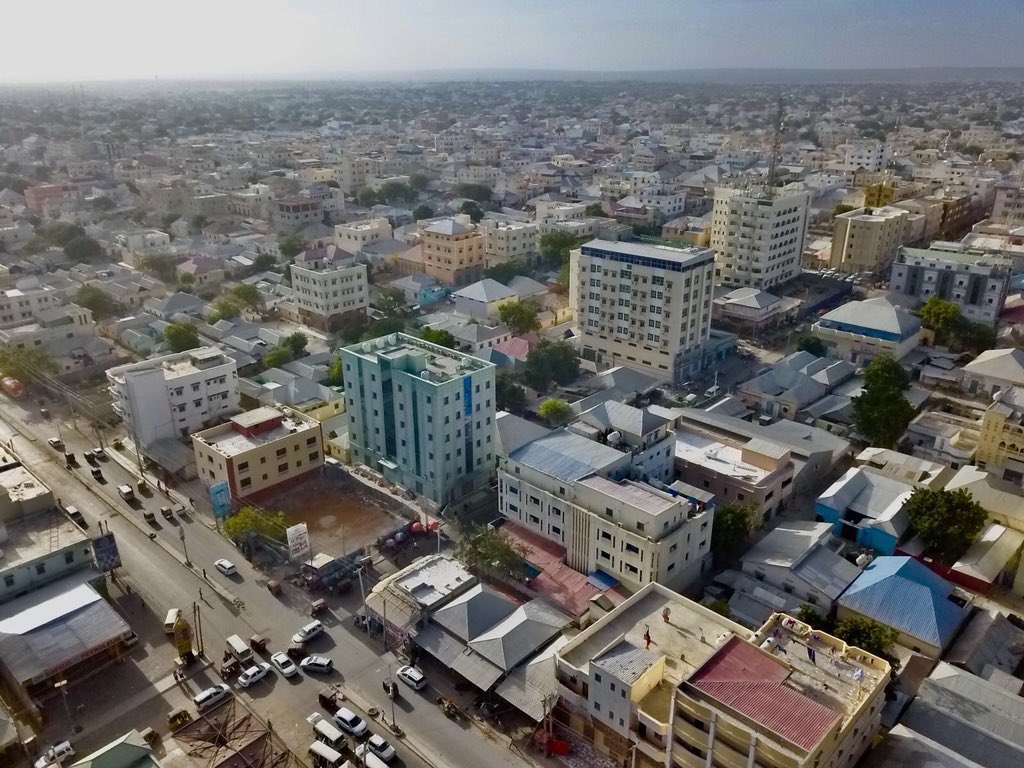
Howlwadaag District (Mogadishu)
Howlwadaag sits near the center of Mogadishu, within the wider Banaadir region that covers the Somali capital. Look at the city map for a while and the district almost starts to feel unavoidable — right in the thick of it, ringed by neighborhoods where people live, trade, pray, argue, open small businesses, and disappear into the rush of daily errands. This is not some quiet outer edge. It is part of the urban core.
Among the roughly seventeen administrative districts that make up the city, Howlwadaag carries a reputation that travels far beyond its own streets. The reason is obvious enough: Bakara Market. The huge trading hub sits inside the district and pulls in merchants, wholesalers, transport operators, mechanics, vendors, and buyers from across Mogadishu and from other parts of Somalia too. Follow the movement of electronics, textiles, construction materials, or food shipments through the capital and sooner or later the trail usually runs through Howlwadaag.
The district did not begin in that form. It started out quieter. Over time the place changed shape as residential blocks mixed with trade corridors, warehouses appeared beside homes, and commercial traffic pressed deeper into the street network. What you get now is a district where domestic life and business are tightly entangled. Shops below apartments. Storage spaces beside family houses. Narrow streets filled with people carrying goods, heading to work, or trying to get through the market before the next crush of traffic.
Administrative Overview
Howlwadaag functions as one of the official districts within the Banaadir regional administration, the structure that governs the wider metropolitan area of Mogadishu. Like the other districts, it has a local commissioner responsible for coordinating public services, maintaining contact with community groups, and handling everyday administrative matters that rarely sound dramatic but matter anyway.
| Administrative Level | Name |
|---|---|
| Country | Somalia |
| Region | Banaadir |
| City | Mogadishu |
| District | Howlwadaag |
District authorities work under the broader leadership of the Governor of Banaadir, who also serves as the Mayor of Mogadishu. The arrangement blends city governance with regional administration, a system shaped over time as the capital expanded and the demands of urban management became more complicated.
At district level the work is practical. Municipal maintenance, coordination with police units, small infrastructure issues, public order, communication with elders, mediation when local disputes need to be cooled down before they grow teeth. Nothing glamorous about it. Just the basic machinery of urban administration.
Location within Mogadishu
Geographically, Howlwadaag lies in the north-central part of Mogadishu. The location matters more than people sometimes assume. Major urban corridors run nearby, linking residential areas to commercial zones, government districts, and coastal parts of the city closer to the Indian Ocean.
Neighboring districts include:
- Hodan
- Warta Nabada (formerly Wardhigley)
- Hamar Jajab
- Shibis
That position places Howlwadaag inside one of the densest clusters of city districts. Movement between these neighborhoods is constant. Traders hauling goods, commuters heading to offices, students on foot, delivery drivers nosing through traffic. Some roads feel less like streets and more like permanent channels of motion.
The district’s position also helps explain its commercial weight. Goods arriving from the port, supplies moving inland, stock shifting between warehouses and retail areas — a lot of that pressure gathers here. The district absorbs it, redirects it, and keeps moving.
Urban Landscape
The physical layout of Howlwadaag tells a story of layered growth. Some parts still carry traces of planned urban development — straighter roads, defined residential blocks, municipal buildings that look like they belong to an earlier idea of the city. Other parts feel more improvised. Streets bending off the grid a little, clusters of businesses appearing wherever trade found enough space to survive.
Walk through the district and the mix becomes obvious fast. Apartment buildings, retail storefronts, warehouses, mosques, guesthouses, mechanics’ workshops, food stalls, tiny grocery shops stacked with imported goods. Everything sits close, sometimes uncomfortably close.
Typical features of the district include:
- dense residential neighborhoods
- mixed commercial streets with shops and offices
- large open market spaces
- mosques and community institutions
- small hotels and restaurants serving traders
Many structures follow a pattern common in older parts of Mogadishu. Ground floors hold shops or storage rooms, upper floors hold apartments. Traders live above their businesses. Families occupy buildings that also generate income. That overlap between home life and commerce is one of the defining textures of the district.
At times the place feels noisy and chaotic. At other times it simply feels busy in a very ordinary city way. Markets open early, deliveries arrive before noon, afternoon crowds thicken, and by evening some of the residential streets finally begin to soften.
Historical Background
The development of modern Howlwadaag goes back to the period when Mogadishu expanded beyond its older coastal quarters. During the mid-twentieth century the capital grew quickly as people arrived from different parts of Somalia looking for government jobs, business opportunities, or simply a place inside the country’s largest city.
Urban planning efforts encouraged new residential districts outside the older urban core. Howlwadaag emerged during that period as a neighborhood with planned housing and municipal infrastructure intended largely for civil servants and middle-income residents.
That identity did not last unchanged.
As commerce expanded across Mogadishu, the area gradually attracted traders, wholesalers, and transport businesses. Markets grew, smaller commercial streets multiplied, and economic activity steadily reshaped the district. Residential areas remained, but trade kept pressing outward from the market zone until the district developed into something more mixed and far more intense than its original layout suggested.
Major Urban Features
| Urban Feature | Description |
|---|---|
| Bakara Market | Largest commercial market in Somalia |
| Residential Blocks | Densely built housing areas |
| Mosques | Important religious and community centers |
| Local Shops | Retail businesses serving residents and traders |
| Transport Routes | Major streets linking central districts of Mogadishu |
Bakara Market gives the district its economic profile, but it does not erase everything else. Alongside the market corridors there is still a web of residential streets where families live, children walk to school, and mosques anchor local routines. The pace changes once you leave the busiest commercial sections. Not quiet exactly, but different.
Bakara Market
The market was established in 1972 as a wholesale agricultural storage and distribution area. The original idea was fairly direct: grain warehouses, food supplies, and basic commodity trade. Even the name “Bakara” comes from a Somali term associated with grain storage. Simple enough at the start.
Then the market grew in the way large markets usually do — unevenly, aggressively, almost with a mind of its own. It expanded far beyond food distribution. Textiles came in. Electronics followed. Construction materials, mobile phones, spare parts, medicine supplies. What began as a storage and wholesale zone eventually turned into a sprawling commercial district inside the district itself.
Today thousands of shops operate inside Bakara’s maze. Warehouses line entire streets. Some stalls look temporary, others look as if they have been standing there through every political turn and every economic shock the city could throw at them.
| Market Feature | Description |
|---|---|
| Year Established | 1972 |
| Location | Howlwadaag District, Mogadishu |
| Market Type | Open-air commercial market |
| Scale | Largest market in Somalia |
| Main Activities | Wholesale and retail trade |
Because of its reach, Bakara acts as one of the main commercial nerve centers of Mogadishu. When imports arrive, prices shift, or supply chains tighten, the changes tend to show up here first.
Market Structure
Despite the apparent chaos, Bakara is not random. Traders tend to cluster by product. Electronics gather in one section, textiles in another, construction materials in areas where trucks can reach warehouses more easily. Buyers learn the internal logic quickly, even if the place still feels overwhelming the first few times through.
Honestly, the system developed organically. Nobody sat down and designed the full layout from scratch. Merchants settled near others selling similar goods, customers learned where to go, and over time those patterns hardened into something like an informal map.
Typical sections inside the market include:
- grain and agricultural produce markets
- textile and clothing areas
- electronics and mobile phone shops
- construction material suppliers
- pharmaceutical and medical supply sections
- household goods markets
Many stalls are family businesses. Some have operated long enough that regular customers know the owners by name, not just by product. A single stall can turn into two, then three, then a small cluster controlled by the same family within one lane of the market.
Wholesale Trade
Wholesale trade is the heavy backbone of Bakara’s economy. Large shipments of goods arrive through Mogadishu’s seaport and move inland toward warehouses in and around Howlwadaag. From there, wholesalers distribute products to smaller merchants across the capital and into regional markets.
Rice sacks stacked in high piles. Containers of cooking oil. Sugar, flour, cement, electronics still packed in international cartons. The scale can surprise people who only think of the district as a crowded retail zone. Entire truckloads are unloaded, sorted, and moved onward with brutal efficiency.
Smaller traders buy goods in bulk and carry them farther inland, linking the district to wider commercial networks across southern and central Somalia.
| Wholesale Goods | Main Sources |
|---|---|
| Rice and grain | Imported from Asia and regional suppliers |
| Sugar and flour | International trade networks |
| Electronics | Imported through international ports |
| Clothing | Regional and global textile markets |
| Construction materials | International suppliers and regional factories |
Through that constant flow of bulk goods, Howlwadaag operates as an important distribution center for much of southern Somalia.
Retail Economy
Wholesale trade may carry the larger weight, but the district’s street-level energy comes from retail. Thousands of small businesses line the roads around Bakara Market, many occupying spaces barely wider than a doorway.
Retailers survive through specialization. One shop sells only mobile phone accessories. Another focuses on cooking utensils. A few stalls farther down, someone repairs electronics. A customer looking for cosmetics may stop at several vendors in the same alley before deciding where to buy.
Typical retail businesses found around the market include:
- mobile phone repair shops
- clothing stalls
- food vendors
- electronics shops
- kitchenware retailers
- cosmetics and household products
It is noisy work. Negotiations never really stop. Prices shift with supply, personal relationships, and sometimes the mood of the trader standing behind the counter.
Informal Financial Services
Trade requires money to move quickly, and the district developed a financial ecosystem to match that pressure. For long periods Somalia’s formal banking system struggled, so merchants relied heavily on alternative structures.
Remittance companies became essential. Somali communities abroad regularly send funds to relatives and business partners back home, and those transfers often pass through offices located in commercial districts like Howlwadaag.
Currency exchange desks sit beside trading stalls. Mobile payment services handle everyday transactions. Informal lending agreements circulate quietly between trusted business partners who already know who pays on time and who doesn’t.
Financial services commonly operating in the district include:
- remittance companies
- currency exchange traders
- informal lending networks
- mobile money payment services
This financial web keeps trade moving with remarkable speed. Funds arrive, goods move, accounts settle, and sometimes the whole cycle turns within a single afternoon.
Employment and Livelihoods
The scale of economic activity in Howlwadaag supports livelihoods for thousands of people. Some work as merchants. Others move goods between warehouses. Drivers carry supplies across the city or toward regional towns.
There are also quieter roles behind the scenes — repair technicians fixing electronics, porters hauling sacks through crowded lanes, delivery workers pushing carts over broken pavement, service workers feeding the market workforce from nearby restaurants and tea shops.
- market traders
- warehouse workers
- transport drivers
- street vendors
- repair technicians
- porters and delivery workers
The district’s economy is not only about major traders. It also depends on all the smaller jobs that keep the place functioning hour after hour.
Regional Trade Networks
What happens in Howlwadaag does not stay neatly inside the district. Trade networks extend far beyond Mogadishu, linking Bakara Market to suppliers and buyers across a much wider region.
Imported goods arriving at the port often pass through Bakara before moving inland. Trucks leave carrying merchandise toward smaller markets throughout southern Somalia, while other routes connect to central regions and cross-border commercial circuits in the Horn of Africa.
| Trade Route | Connection |
|---|---|
| Mogadishu Port | Primary entry point for imported goods |
| Southern Somalia | Distribution of agricultural products and supplies |
| Central Somalia | Trade in consumer goods and construction materials |
| Regional Horn of Africa | Cross-border trade networks |
In that sense, Howlwadaag acts as a bridge between international supply chains and local markets. Goods flow inward through the port and outward again through merchant networks that reach well beyond the capital.
Population
Exact population figures for individual districts of Mogadishu are difficult to pin down. Census systems have not operated consistently for decades, so most numbers come from estimates, municipal assessments, and demographic studies. Even so, the broader pattern is clear: Howlwadaag has a large permanent population, and the number rises sharply during working hours.
Tens of thousands of residents live in the district. Daytime activity pushes that figure much higher as traders, transport workers, laborers, and customers move in and out of the area.
| Population Indicator | Estimated Information |
|---|---|
| Permanent residents | Tens of thousands |
| Daily working population | Large number of traders and workers |
| Urban density | High compared with many other districts |
| Main population groups | Urban residents, traders, migrants |
That daily surge makes the district one of the busiest parts of the city during commercial hours, especially in streets closest to the market.
Community Structure
Historically the district has been associated with the Murusade clan, part of the larger Hawiye clan family. Over time, though, Howlwadaag became more socially mixed as migration reshaped Mogadishu and traders from different regions settled in the capital.
Community life does not revolve around one formal authority. It is layered. Neighborhood elders, mosque leaders, business owners, extended families, and local networks all play roles in maintaining social order and resolving problems before they become something worse.
Local institutions that shape everyday community life include:
- mosques and Quranic schools
- small neighborhood markets
- community elders and mediation networks
- family-run businesses inside Bakara Market
In crowded urban districts, those informal systems matter a great deal. They help hold things together when official structures are not enough on their own.
Education and Social Institutions
Large universities are located elsewhere in Mogadishu, but Howlwadaag still contains several educational institutions serving the surrounding population. Schools in the district tend to be smaller, sometimes private, sometimes connected to community organizations or religious networks.
Many children attend neighborhood primary schools before continuing their education in other parts of the city. Religious learning remains visible as well, with Quranic education often running alongside formal schooling.
| Institution Type | Description |
|---|---|
| Primary schools | Local schools serving neighborhood families |
| Religious schools | Quranic education and Islamic studies |
| Mosques | Centers for worship and community meetings |
| Private learning centers | Language training and technical courses |
That blend of formal education and religious instruction reflects a broader pattern found across much of Mogadishu.
Religious Life
Islam shapes everyday life throughout the Somali capital, and Howlwadaag is no exception. The rhythm of the day often follows prayer times, and the sound of the call to prayer carries across both market lanes and residential streets.
Mosques serve as more than places of worship. They also function as community spaces where residents discuss local matters, organize charitable work, exchange news, and sometimes settle disputes.
During major religious holidays the district takes on a different atmosphere. Streets fill with worshippers, families visit relatives, food moves from household to household, and the commercial rush eases for a while.
Infrastructure and Urban Services
Infrastructure in Howlwadaag reflects both the pressure and resilience of a dense urban district. Main roads linked to the market are paved and heavily used, while smaller streets in residential areas remain narrow and crowded with buildings that grew around older layouts.
Municipal authorities and private service providers maintain essential services across the district, though managing infrastructure inside such a packed commercial environment is never simple.
Urban services available in the district include:
- municipal sanitation and waste collection
- fire response teams near major market sections
- local police coordination
- private clinics and neighborhood pharmacies
Fire prevention is especially important in a district filled with warehouses, electrical equipment, fuel, and dense commercial storage spaces. Emergency response units nearby can make a real difference when something goes wrong.
Housing and Urban Density
Housing across the district follows a compact urban pattern. Streets run close together, and buildings stand almost wall-to-wall in some areas, especially near commercial zones.
Families live in different types of housing depending on income, household size, and access to workplaces.
- traditional urban houses
- small apartment buildings
- mixed residential and commercial structures
- informal housing developments
Living near the market can be practical. Many traders walk to work, open their shops within minutes of leaving home, and stay tied closely to the daily rhythms of the district’s commercial life.
Local Transportation
Transportation inside the district relies on flexible small-scale systems rather than large formal transit networks. Minibuses, motorcycle taxis, delivery trucks, and hand carts all play different roles in moving people and goods through crowded streets.
| Transport Type | Role in District |
|---|---|
| Minibuses | Public transport between Mogadishu districts |
| Motorcycle taxis | Short-distance travel inside neighborhoods |
| Delivery trucks | Transport of goods for market businesses |
| Hand carts | Movement of goods within crowded market areas |
Traffic builds quickly around the busiest commercial zones, especially where narrow streets feed into larger roads. Drivers edge around delivery trucks, minibuses stop for passengers, motorcycles cut through gaps, and pedestrians move through it all carrying merchandise, groceries, or whatever else the day requires.
Key transportation characteristics include:
- heavy daily vehicle traffic near market areas
- transport routes connecting the district to Mogadishu Port
- bus and minibus routes linking surrounding neighborhoods
- delivery trucks supplying market merchants
Pedestrian movement can be even more intense than vehicle traffic during peak trading hours. That is when the district feels most compressed, most active, most unmistakably central to the city’s commercial life.
Urban Challenges
Like many dense commercial districts, Howlwadaag faces a set of familiar urban pressures.
- traffic congestion during busy market hours
- limited space for expansion
- occasional fires in crowded trading areas
- pressure on sanitation systems
Municipal planners, local business groups, and service providers continue looking for ways to improve infrastructure and daily management without disrupting the district’s economic role.
Modern Development
Despite those pressures, the district remains one of the most economically active parts of Mogadishu. Trade continues to attract investment, new shops appear, storage facilities expand, and logistics services adapt to meet the demands of a city that keeps rebuilding itself.
Reconstruction elsewhere in the capital has also fed new activity here. Fresh storefronts rise beside older structures, and private investment keeps filtering into the commercial landscape around the market.
Markets have a stubborn way of surviving. Bakara proves that every day.